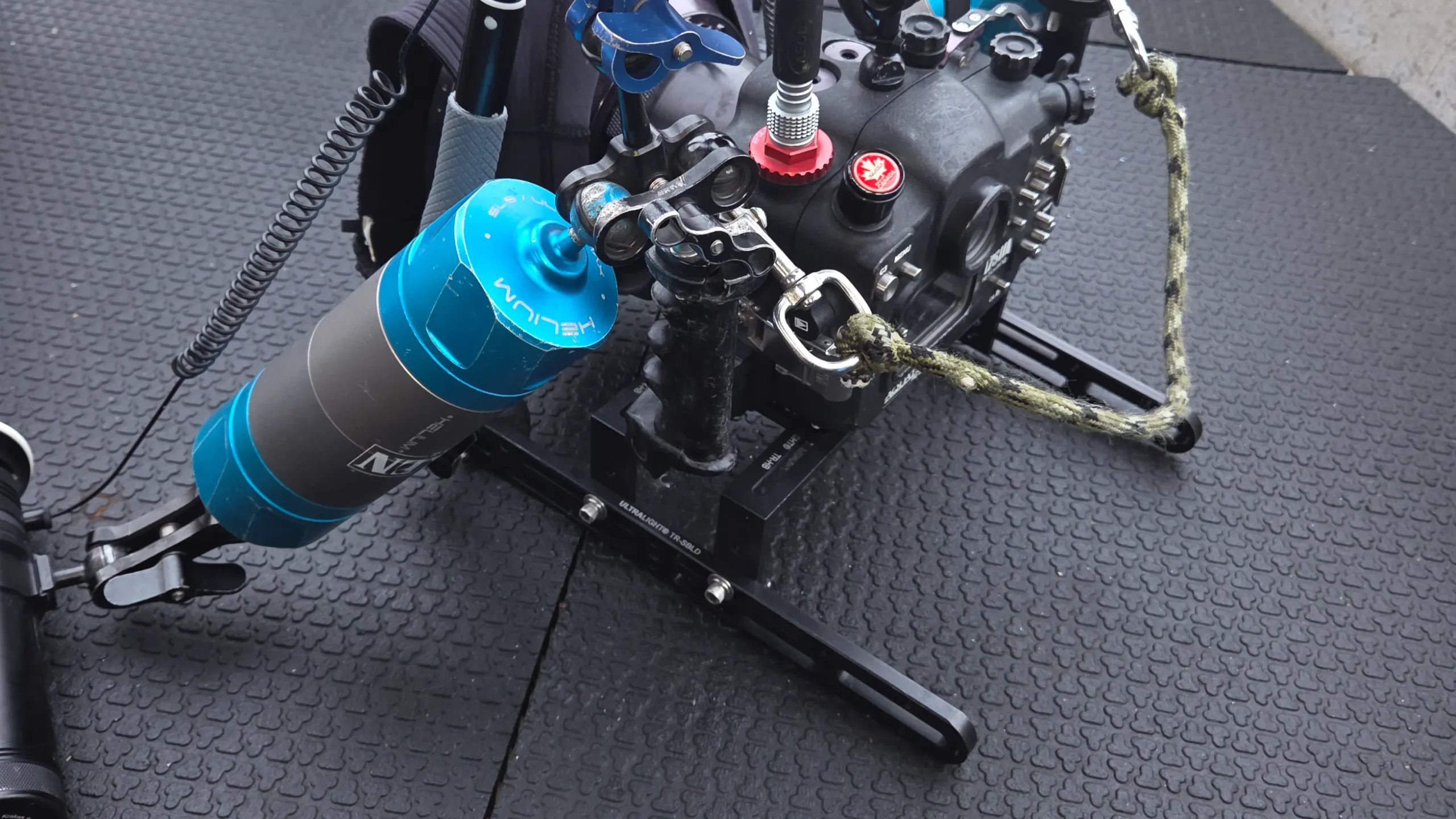
Ultralight Camera Solutions Large Camera Sled
Finding underwater camera accessories that can withstand the realities of cold-water diving is not always easy. Between rugged shore entries, rough boat rides, heavy camera systems, and long filming days, equipment needs to perform reliably in conditions that are far more demanding than the average tropical dive vacation.
Over the past several months, I've used the Ultralight Solutions Large Camera Sled on more than 100 dives around Vancouver Island, British Columbia. It has been used on shore dives, charter boat dives, wreck dives, macro dives, and wide-angle filming projects in some challenging sea conditions.
This is not a first-impressions review based on a handful of dives. The sled has become a regular part of my underwater camera setup, and I've had plenty of time to evaluate where it excels and where there is room for improvement.
Disclosure
Ultralight Camera Solutions provided the Large Camera Sled featured in this review. They did not pay for this review, request a positive review, or have any input into the content before publication.
Everything below is based entirely on my own experience extensively using the sled in real-world diving conditions around Vancouver Island.
Why This Review Matters
Most underwater camera accessory reviews are written after only a few dives, often with relatively lightweight camera systems and in warm-water environments.
My experience is quite different.
The Ultralight Solutions Large Camera Sled has been used on more than 100 dives with a 36-pound professional underwater video rig. It has been exposed to rough shore entries, boat diving, heavy current, cold water, and the day-to-day abuse that comes with filming underwater on a regular basis.
If you're considering this sled for a serious underwater photography or videography setup, especially in cold-water conditions, this review reflects long-term use rather than first impressions.
Quick Verdict
Overall Rating: 9/10
Best For
- Underwater videographers
- Large mirrorless and DSLR systems
- Cinema-style underwater camera rigs
- Divers running monitors and multiple lights
- Cold-water diving environments
May Be Overkill For
- Compact camera systems
- Lightweight travel rigs
- GoPro-only setups
My Camera Setup
To put this review into context, the sled is supporting a fairly substantial camera system:
Camera
- Sony A7S III
Housing
- Aquatica Digital Housing
Optics
- Aquatica 9.25" Glass Dome Port
- Laowa 10mm Ultra-Wide Lens
- Sony 16-35mm
- Sony 90mm
- Sony 100mm
- Sony 24-70mm GMII
Monitoring
- Anglerfish Underwater Monitor
Lighting
- Three Kraken Sports 15,000 Lumen Video Lights
- Kraken Remote Control System
The complete setup weighs approximately 36 pounds out of the water give or take a tiny amount depending on the lens or port combination.
This isn't a small recreational camera rig. I needed something durable, stable, and capable of supporting significant weight both underwater and on the surface.
Why I Started Looking For A Camera Sled
Before using the Ultralight Solutions sled, I relied on inexpensive generic camera trays purchased online.
They worked reasonably well, but several limitations became apparent as my camera system grew larger and more complex.
Stability Was Limited
On dive boats, especially in rough weather, I was always concerned about the camera tipping over or resting awkwardly on the dome port.
Setting the rig down between dives often felt risky, particularly when dealing with larger swells or crowded boat decks or handing my camera off to boat captains or deckhands was always a risk.
Accessory Mounting Was Restrictive
Most generic trays offer no flexibility when it comes to adding accessories.
As my setup evolved, I wanted mounting points for:
- White balance cards
- Action cameras
- Additional accessories
- Future upgrades
The trays I had been using simply didn't offer that flexibility.
Larger Rigs Need More Support
As camera systems get bigger and heavier, stability becomes increasingly important.
I wanted a platform designed specifically for large professional camera systems rather than trying to push a lightweight tray beyond its intended use.
Fitment With Aquatica Housings
One of my biggest concerns before receiving the sled was compatibility with my Aquatica housing.
Anyone who shoots with Aquatica systems knows that not every accessory fits perfectly. Certain dome port and extension combinations can create clearance issues that aren't always obvious until you attempt installation.
Before the sled was shipped, I contacted Ken at Ultralight Solutions to discuss my setup.
At the time, I was using Aquatica's prototype 9.25-inch glass dome port with the Laowa 10mm ultra-wide lens.
Unlike many dome port configurations, this setup does not use a traditional extension ring. Instead, the rear portion of the dome tapers directly into the housing mount.
This creates very little clearance between the rear of the dome port and the tray when attached to the housing, regardless of the tray being used. (I had the same issue with my cheap trays)
Ken was quick to respond and asked for measurements and photographs of the housing and mounting points. Based on those measurements, we confirmed that the sled would fit and discussed the dome port clearance concerns before moving forward.
I appreciated the willingness to work through those questions rather than simply assuming compatibility.
Build Quality And Construction
The first thing that stood out when I assembled the sled was how substantial it feels.
This is clearly a product designed for larger camera systems and professional use.
Construction Highlights
- Heavy-duty aluminum construction
- Stainless steel hardware and fasteners
- Adjustable width for different housing sizes
- Extremely rigid design
- Multiple mounting locations
- Sliding and fixed 1-inch ball mount positions
Assembly was straightforward, and the included hardware felt high quality throughout.
After more than 100 dives, including rough shore entries and demanding boat conditions, the sled continues to look and perform exceptionally well.
In-Water Performance
Stability On Dive Boats
One of the biggest improvements compared to traditional trays has been stability on dive boats.
The wide stance of the sled creates a solid platform that allows the camera to sit securely on deck without constantly worrying about it tipping over.
During multiple trips involving whitecaps, rolling seas, and rough weather, the sled kept the camera stable and upright.
This alone has reduced a lot of stress when transporting and handling the camera between dives.
Easier Battery Changes Between Dives
The stable platform has also made battery changes much easier.
Rather than trying to balance the camera while opening the housing, the sled provides a solid base that supports the entire system while changing batteries or making adjustments.
It's a simple benefit, but one that becomes increasingly valuable when working with larger camera systems.
Shore Diving Around Vancouver Island
Many of our shore dives involve uneven rock, slippery surfaces, and long walks carrying equipment.
The sled has handled this environment exceptionally well.
Whether scrambling over rocks during low tide or carrying the camera through rugged shoreline entries, the sled has proven durable and confidence-inspiring.
Nothing about it feels fragile.
Wide-Angle Videography
The rear rails have become useful handholds while filming.
They provide additional points of contact that help stabilize the camera and create smoother movements during wide-angle sequences.
For underwater videographers, small improvements in stability often translate directly into better-looking footage.
Macro Videography
One unexpected benefit has been how useful the sled is during macro filming. Many of my macro dives take place on sandy or rocky bottoms where stability is critical.
The sled allows me to carefully rest the camera on the substrate and create a very stable filming platform without worrying about damaging the housing or dome port.
I may eventually upgrade my macro setup to an underslung tripod, but the sled already performs surprisingly well in this role.
The Features I Use Most
White Balance Card Mount
This has been the single most valuable feature for my style of filming.
The additional mounting locations allowed me to install a selfie stick on the front of the sled with a dedicated white balance card attached.
For those who film in British Columbia's green-water conditions, achieving consistent color can be challenging.
Before using the sled, I would often white balance using:
- Sand
- A buddy's scuba tank
- White plumose anemones
While those methods worked, the results were not always consistent and not always available to use.
With a dedicated white balance card permanently mounted to the sled, I can achieve far more reliable color correction throughout my footage.
For me, this has genuinely improved both workflow and final image quality.
Insta360 Mounting
The additional mounting points have also allowed me to add an Insta360 camera to the front of the rig.
This has opened up creative filming angles that would have been difficult to achieve with my previous tray setup.
Accessory Expansion
The flexibility offered by the sled is one of its strongest features.
Whether you're adding:
- Additional lights or strobes
- Monitors
- Action cameras
- White balance tools
- Future accessories
There is plenty of room to configure the sled to suit your specific needs.
What I Like
- Extremely stable platform
- Excellent build quality
- Adjustable width for different housing sizes
- Large number of mounting options
- Performs well on rough boat decks
- Makes battery changes easier
- Useful for macro videography
- Additional handholds improve stability underwater
- Well suited for cold-water diving
- Excellent customer support
What I Don't Like
No product is perfect, and there are a few minor quirks worth mentioning.
Thumb Screws Can Loosen
The thumb screws that secure the housing to the sled occasionally work themselves loose.
I suspect this happens primarily during shore dives where my legs frequently contact the sled rails while walking.
It hasn't caused a problem, but it is something worth checking periodically before entering the water, particularly on deeper dives. You don't want the sled separating from your housing in water to deep to retrieve it!
Monitor Mounting Preference
I also received the optional monitor mounting bracket.
While I have used it, I ultimately prefer my monitor mounted on top of the housing rather than behind it.
Most of my filming takes place in benthic environments close to the sea floor. With the monitor positioned on top of the housing, I find it much easier to maintain a comfortable shooting position.
Divers who spend more time filming in blue-water environments may have a very different experience and will probably prefer the rear-mounted monitor configuration.
Who Should Buy The Ultralight Solutions Large Camera Sled?
This Sled Is A Great Choice If You:
- Shoot with a full-frame mirrorless or DSLR system
- Run multiple video lights
- Use an external monitor
- Create professional underwater video content
- Frequently dive in rough conditions
- Want more accessory mounting options
You May Not Need It If You:
- Primarily shoot with a GoPro
- Use a very lightweight camera setup
- Prioritize compact travel gear
Final Thoughts
After more than 100 dives in British Columbia's cold-water environment, the Ultralight Solutions Large Camera Sled has earned a permanent place in my camera setup.
The stability, mounting flexibility, rugged construction, and ability to support large professional camera systems make it an excellent platform for serious underwater videographers.
While it may be more sled than some divers require, those running larger mirrorless, DSLR, or cinema-style underwater rigs will likely appreciate the added stability and versatility it provides.
For cold-water divers and underwater videographers looking for a rugged, highly configurable platform for a professional camera system, the Ultralight Solutions Large Camera Sled is easy to recommend.