Shipwrecks of British Columbia (Underwater Film)
Featuring underwater footage from Vancouver Island wrecks including HMCS Saskatchewan, Cape Breton, Rivtow Lion, and the Vanlene.
Shipwrecks off the coast of Vancouver Island offer a completely different kind of underwater environment.
From large artificial reefs near Nanaimo to scattered wreckage in Barkley Sound, these sites combine structure, depth, and marine life in ways that are rarely seen from the surface.
This episode of the Ambient Film series, produced by Ambient Film and now streaming on PBS, features underwater footage captured across multiple wreck dives, showing both intact ships and long-since broken structures now covered in marine life.
Explore underwater shipwrecks in 4K, from fully intact naval vessels to scattered wreckage, now home to dense marine life and reef ecosystems.

Highlight Moments From The Film
-
- 01:13 – Remnants of the Vanlene engine scattered across the seabed
- 09:50 – The drive shaft of the Vanlene stretching across the wreck site
- 11:17 – Quillback rockfish resting along the Cape Breton
- 14:18 – Ship railings covered in orange and white plumose anemones
- 16:47 – A large cloud sponge on the port side of the HMCS Cape Breton
- 17:40 – Inside the wreck of the HMCS Saskatchewan
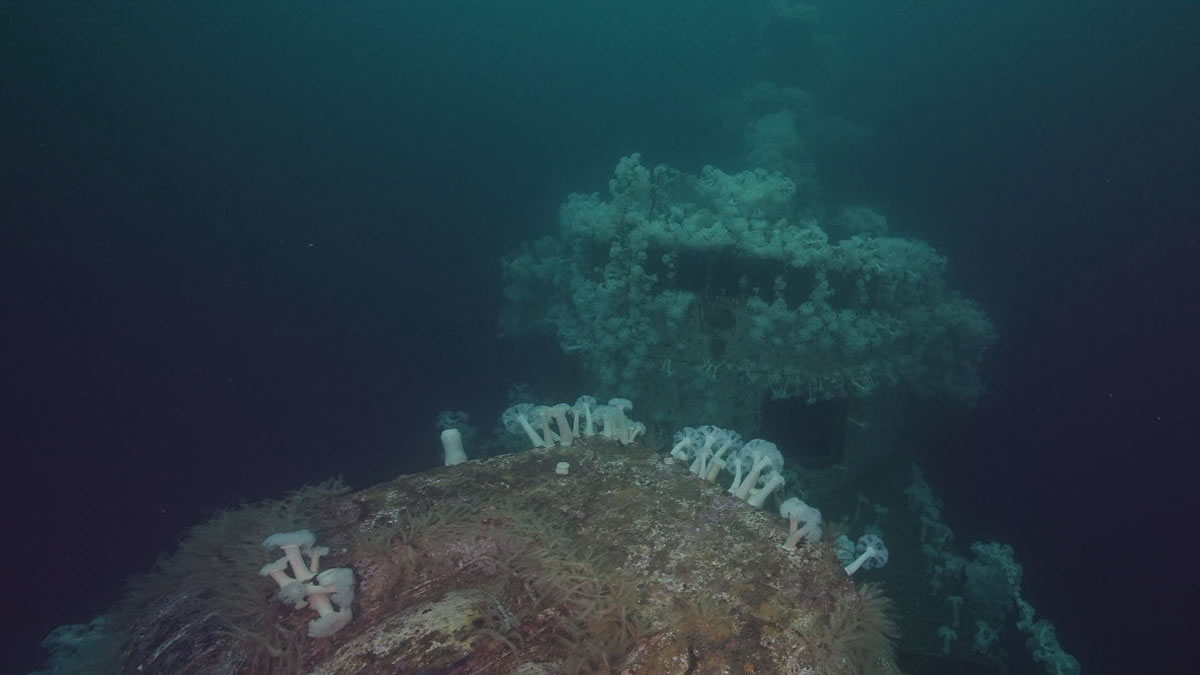
- 24:24 – Plumose-covered bow of the HMCS Saskatchewan
- 37:03 – Schools of fish moving around the Saskatchewan’s superstructure
- 42:17 – The main guns on the bow of the HMCS Saskatchewan
- 46:55 – View of the bridge on the HMCS Saskatchewan
- 48:23 – Bridge structure of the Rivtow Lion
- 52:42 – Propeller of the Rivtow Lion
These moments highlight both the structure of the wrecks and the marine life that has developed around them over time, offering a closer look at details that are easy to miss during a continuous viewing.
Featured on PBS
This film is part of the Ambient Film series, now streaming on PBS, featuring underwater footage captured across Vancouver Island.
Wrecks Featured in This Film
These wrecks are located along the coast of Vancouver Island, primarily near Nanaimo and in Barkley Sound on the west coast. Together, they represent some of the most well-known wreck dives in British Columbia, ranging from large artificial reefs to a true shipwreck broken apart over time.
HMCS Saskatchewan (Nanaimo) - A 366-foot Mackenzie-class destroyer that served in the Royal Canadian Navy before being intentionally sunk in 1997 to create an artificial reef. The ship sits upright in approximately 130 feet of water and remains largely intact, with strong marine growth covering its structure.
HMCS Cape Breton (Nanaimo) - A 441-foot former naval maintenance vessel, and one of the largest artificial reefs in the world. Sunk in 2001, it rests in deeper water at around 160 feet and is known for its massive scale and dense invertebrate life along its vertical surfaces.
Rivtow Lion (Nanaimo) - A steel-hulled tugboat, approximately 140 feet long, sunk as an artificial reef in 2005. Sitting in about 90 feet of water, it offers a more compact structure compared to the naval ships, with easy-to-navigate features and strong marine life presence.
Vanlene (Barkley Sound) - A freighter that ran aground off Austin Island in Barkley Sound on March 14, 1972 while carrying Dodge Colts from Japan to Vancouver. In heavy fog and with limited navigation equipment, the vessel mistakenly entered Barkley Sound instead of the Juan de Fuca Strait and ended up more than 60 km off course before grounding.
All 38 crew members were safely rescued, and over time the ship broke apart and slipped beneath the surface. Today, the Vanlene lies scattered across the seafloor, forming a wide, fragmented wreck site that still supports marine life today.
Marine Life on the Wrecks
Over time, these wrecks have become established reef environments.
Marine life featured in this film includes:
-
- Plumose anemones covering large sections of structure
- Schools of black rockfish and yellowtail rockfish
- Shiner perch moving through the wrecks
- Lingcod and cabezon resting along structure
- Quillback rockfish and other reef species
- Cloud sponges and invertebrate growth
Over time, these wrecks have transitioned from bare structure into fully established reef systems, supporting a wide range of marine life throughout the year.
Filming These Wrecks
This footage was captured over approximately 15 dives, with each dive lasting around an hour.
Filming on wrecks requires:
-
- Careful navigation around large structures
- Managing depth and bottom time on deeper sites
- Maintaining stable buoyancy near vertical surfaces and confined areas
Capturing clean footage often requires multiple dives and careful planning due to these constraints.
These wrecks are rarely seen outside of the diving community, but over time they have become some of the most unique underwater environments on the coast.
This film brings them together into a single, uninterrupted look at how structure, depth, and marine life come together beneath the surface.
Film Credits
Produced by Ambient Film
https://ambientfilm.org/
Underwater footage by Carl Sorensen (ScubaBC)
Music by Nthnl Sound
https://www.nthnlsound.com/
https://www.instagram.com/nthnl.sound/
https://www.youtube.com/@Nthnl_sound
Explore More from the Ambient Film Series
This episode is part of the broader Ambient Film series, which documents unique environments around the world using a slow, observational style.
You can explore more films from the series here:
These episodes highlight underwater environments around Vancouver Island, using my footage to capture shipwrecks, reef systems, and kelp forests in a consistent, long-form format.
More ScubaBC Ambient Videos
If you want to explore similar environments in longer, uninterrupted form, you can watch the full ambient films here:
These films expand on the same locations and marine environments, presented as long-form, no-narration experiences designed for slower viewing, background ambience, or simply spending more time underwater.