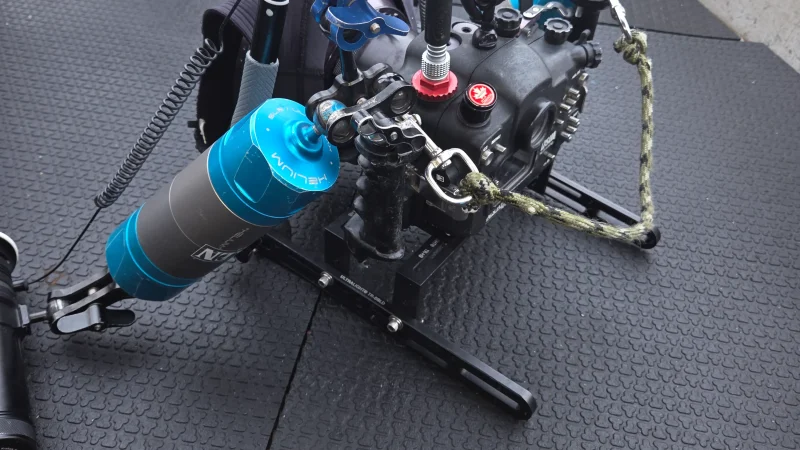
LEFEET P1/XR Review: 100+ Cold-Water Dives With Dual Tank-Mounted Scooters
My real-world experience using the LEFEET P1 underwater scooters for diving, underwater filmmaking, and navigating the challenging waters around Vancouver Island, British Columbia.
Personally purchased equipment. A discount was provided at purchase. This review reflects my own experience. Affiliate links may earn ScubaBC a commission.
From Skeptic to Believer
More than 100 cold-water dives later, here's how these compact scooters changed the way I dive and film.
When I first saw the LEFEET underwater scooters, I wasn't entirely convinced they were anything more than expensive toys. They looked small, and I had a hard time imagining something that compact being particularly useful in the cold, current-swept waters where I regularly dive.
That opinion changed during a dive trip to Port McNeill, British Columbia.
Another diver, David, was using two LEFEET scooters mounted to his scuba tank. He's over six feet tall, dives with a large steel LP130 cylinder, and carries a substantial underwater camera system. Watching him move effortlessly through current and surge while carrying all that equipment certainly got my attention.
One of my regular dive buddies, Tim, purchased a pair shortly afterward. After watching him use them for about a month, I decided to take the plunge myself.
In June 2026, I purchased two LEFEET P1 scooters with the extended-range XR batteries, a wired controller, and the tank-mounting system.
More than 100 cold-water dives later, I can confidently say they've changed the way I dive and film underwater.
They aren't perfect, and there are a few things about the design that frustrate me. But they've also opened up filming opportunities and allowed me to explore areas of familiar dive sites that would have been difficult to reach otherwise.
Here's what I've learned after putting them through some demanding conditions around Vancouver Island.
What I Purchased and What I Paid
My setup consists of two LEFEET P1 scooters, each equipped with an XR extended-range battery, mounted on either side of my scuba cylinder. Both scooters are operated using a wired control system, allowing me to keep my hands on my underwater camera housing.
Because of my website and online presence, I received a discount on the equipment. However, I still paid more than $3,000 CAD for the complete setup, including shipping to Canada.
I purchased these scooters myself, and the opinions in this review are based entirely on my own experience using them.
This is not a review based on a handful of dives in warm, calm water. Since June 2026, I've used these scooters on more than 100 dives, including:
- Nanaimo and Nanoose Bay, including wreck diving on the HMCS Saskatchewan
- Port Hardy and Browning Passage, including several high-current dives
- Barkley Sound and Bamfield, where exposed reefs can experience substantial surge and current
- Nakwakto Rapids, during slack water
Most of these dives involve cold-water equipment, a large steel cylinder, and a professional underwater camera system.
It's a fairly demanding environment for such compact scooters.
First Impressions: Small Scooters, Surprising Power
One of my biggest concerns before purchasing the P1 scooters was whether they would have enough power to move me and all my equipment effectively.
I'm approximately 250 pounds, and my dive equipment adds considerable weight. I typically dive with a steel LP130 cylinder, a stainless backplate, ditchable lead, and a camera housing that weighs approximately 36 pounds out of the water, although the camera system is neutrally buoyant underwater.
I'm certainly not a small diver travelling light!
Despite this, the dual P1/XR setup moves me through the water with surprisingly little effort.
The scooters have enough thrust to make long swims considerably easier, and having several speed settings makes them useful for much more than simply getting from one location to another.
For me, the real benefit is having propulsion available without needing to kick, particularly when I'm filming.
That has turned out to be far more valuable than I originally expected.
Tank Mounting, Weight and Trim: There's a Learning Curve
The dual tank-mounted setup is one of the features that attracted me to these scooters in the first place.
As an underwater filmmaker, I frequently have both hands occupied operating my camera. A traditional handheld DPV isn't particularly practical when I'm trying to maintain precise camera movements, adjust framing, or follow marine life.
Mounting the scooters to my tank solves that problem, but it introduces a few challenges of its own.
The Additional Weight
With both scooters and their mounting equipment attached, I'm carrying approximately 14.5 pounds of additional weight.
To compensate, I've removed roughly 14 pounds of lead from my normal weighting configuration.
That largely offsets the additional weight, but it doesn't mean the scooters have no effect on your buoyancy or trim. Their position on your tank changes how your equipment is balanced, and that takes some getting used to.
Getting Your Trim Right
I found achieving comfortable trim more difficult than expected.
With two propulsion units mounted behind you, small changes in your body position can become much more noticeable once the scooters are running.
Add a large camera housing in front of you, and finding the right balance becomes even more important.
It took several dives before I became comfortable with the setup.
One improvement I'd really like to see is an adjustable mounting angle that would allow divers to change the direction of thrust relative to their tank.
I suspect this could make fine-tuning trim easier, although I haven't had the opportunity to test that theory.
Modifying the Tank Mounts
I also wasn't particularly happy with the supplied tank-mounting arrangement.
The rubber backing pieces and sliders made the entire assembly bulky and difficult to adjust.
I eventually removed those components and positioned the metal mounting brackets over my existing tank bands instead.
That made my setup easier to manage, although this is my personal mounting arrangement rather than a manufacturer-approved modification. Anyone considering changes to their mounting system should ensure the scooters remain securely attached.
Once everything is positioned correctly, the tank-mounted configuration is excellent for hands-free filming.
Getting there just requires patience.
The Five Speed Settings: Which Ones Do I Actually Use?
Although the P1/XR offers five speed settings, I spend almost all my time using speeds 1, 2, and 3.
Each has a practical purpose, and I've developed a pretty consistent approach to choosing between them.
Speed 1: Perfect for Underwater Cinematography
This is easily my favourite setting for filming.
At speed 1, the scooters move me gently through the water at a pace that works beautifully for long, slow tracking shots.
One of the challenges of filming underwater while swimming is that every fin kick can introduce small movements into the camera.
Even with good buoyancy control and careful finning, those movements can be noticeable when filming wide-angle scenes.
With the scooters, I can move through a kelp forest, follow a rocky reef, or travel along an underwater wall without kicking at all.
The result is much smoother footage, particularly when filming long, uninterrupted sequences.
In calm conditions with little current, speed 1 is often all I need.
It's also excellent for conserving battery power.
Speed 2: My Most Versatile Setting
Speed 2 is what I use when I need to cover ground or move against a moderate current.
For example, some of our shore dives around Nanoose Bay involve fairly long swims before reaching the most interesting areas.
Sites such as Madrona Point and Oak Leaf are good examples.
Rather than spending a significant portion of the dive swimming to the wall, I can use the scooters to make the transit much easier.
Speed 2 is also particularly useful when filming moving marine life.
I've used it while following giant Pacific octopuses, wolf eels, a mola mola (ocean sunfish), and even a sixgill shark.
Having the ability to adjust my speed without kicking makes it much easier to maintain a consistent filming distance and keep the camera steady.
Speed 3: Where the Extra Power Becomes Valuable
Speed 3 has surprised me the most.
On several dives around Port Hardy, Browning Passage, and Barkley Sound, I've encountered currents strong enough to make swimming against them difficult.
With both P1 scooters running at speed 3, I've been able to make progress against currents that prevented some other divers from reaching the same areas.
That extra propulsion can be extremely useful, but it shouldn't be mistaken for a guarantee that the scooters can overcome any current.
Conditions can change quickly, and a DPV doesn't replace proper dive planning, current awareness, or having a safe exit strategy.
Still, having that additional power available has made a meaningful difference on a number of my dives.
Speeds 4 and 5: Fun, but Rarely Necessary
The XR battery configuration provides access to speed 5, also referred to as Sport Mode.
It's certainly fun to experience how quickly these little scooters can move you through the water.
However, with my tank-mounted configuration and large camera housing, the higher speeds become much harder to manage comfortably.
Maintaining trim and controlling my camera are more difficult, and battery consumption increases considerably.
For the type of diving and filming I do, speeds 4 and 5 simply aren't necessary most of the time.
I would much rather have smooth, controlled movement than maximum speed.
Compact Propulsion for Real-World Diving
Explore the LEFEET P1 and XR battery options, including configurations for recreational diving and hands-free filming.
Battery Life & Reliability
What I've learned about the XR batteries and long-term scooter reliability after more than 100 dives in cold saltwater.
Battery Life: Three Dives on a Single Charge
PER CHARGE
Battery life has been one of the pleasant surprises of owning the P1/XR scooters.
My typical dives last approximately 60 minutes, and I can comfortably complete three dives on a single charge using both scooters.
That's approximately three hours of total dive time, although it's important to understand that I'm not running the scooters continuously.
I use them intermittently throughout each dive, primarily when filming, covering longer distances, moving against current, or returning to the boat.
Most of that time is spent using speeds 1 through 3.
At those settings, I've found the XR batteries easily last an entire day of diving without needing to recharge between dives.
Of course, battery consumption increases considerably at speeds 4 and 5, and divers who use their scooters continuously should expect substantially shorter runtimes.
I haven't performed controlled endurance testing, so these are real-world observations rather than measured continuous operating times.
Still, considering my size, the amount of equipment I carry, and the conditions I regularly dive in, I've been extremely happy with the battery performance.
If I were purchasing the P1 scooters again, I'd choose the XR batteries without hesitation.
The additional battery capacity is well worth having, particularly when you're doing multiple dives in a day.
Reliability After 100+ Cold-Water Dives
DIVES
After more than 100 dives with my dual P1/XR scooters, overall reliability has been very good, although I did experience one incident involving water intrusion.
On one occasion, a single cat hair had found its way onto the internal O-ring seal. Unfortunately, that was enough to compromise the seal and allow water into one of the scooters.
The affected scooter wouldn't turn on afterward.
I cleaned the electrical connections, applied a small amount of dielectric grease, and was fortunately able to get the scooter operating again.
Since then, I've completed more than 30 additional dives with that same unit without experiencing any further problems.
Whether the water intrusion caused any internal damage that might show up later remains to be seen, but so far, the scooter has continued working normally.
The biggest lesson from this experience is to pay very close attention to the O-rings and sealing surfaces whenever assembling the scooters.
A single hair was enough to cause a problem, so I now make a point of carefully inspecting the seals before putting everything together.
Aside from that incident and the occasional communication issues I experienced before adjusting the transmitter position, the scooters have performed very well.
Considering how frequently I use them in cold saltwater, often in strong currents and surge, I've been impressed with their performance and reliability.
It's worth emphasizing that water intrusion can cause hidden corrosion or electrical damage. My scooter's continued operation doesn't guarantee that no damage occurred, and a flooded unit should be assessed according to the manufacturer's guidance before being returned to service.
Explore the LEFEET P1/XR Setup
Compare available scooter configurations and XR battery options before choosing the setup that best fits your diving.
Real-World Diving: Where These Scooters Have Made the Biggest Difference
Specifications and advertised thrust ratings only tell you so much.
What matters to me is how the equipment performs underwater, especially when conditions aren't ideal.
Over the past several months, I've had a number of experiences that really demonstrated the value of the P1 scooters.
Filming Kelp in Strong Current
One of my favourite uses for these scooters has been filming kelp forests in moving water.
Kelp can look incredible when strong currents push the fronds across the reef, but filming that movement smoothly is challenging.
On one dive, I was able to use the scooters to travel against the current while filming the kelp moving around me.
Without propulsion, I would have needed to kick continuously just to make progress.
That would have introduced unwanted camera movement and made the sequence considerably more difficult to capture.
With the scooters, I was able to concentrate on framing and camera movement rather than swimming.
For underwater filmmakers, this is one of the most compelling reasons to consider a hands-free DPV setup.
Real Diving. Real Footage.
Watch the LEFEET P1/XR scooters in use underwater, including footage captured with hands-free propulsion.
High-Current Diving at Hunt Rock, Browning Passage
During a dive at Hunt Rock near Browning Passage, we encountered a substantial current.
I was able to use the scooters to make progress toward the wall while several other divers were unable to reach it.
It was a good demonstration of how useful the extra propulsion can be when conditions are demanding.
However, it's also worth emphasizing that a scooter should never be used as an excuse to push beyond your diving experience or the conditions you've planned for.
Dealing With Downwelling at Danger Rock
Another memorable dive took place at Danger Rock, where my buddy and I were exploring a sea pen slope at approximately 110 feet.
We encountered a strong downwelling current coming off the ridges above us.
Using our scooters, we were able to make progress through the moving water, travel up and over the ridge, and reach calmer conditions.
The scooters were valuable in that situation, although downwelling currents are serious hazards and shouldn't be approached with the expectation that a DPV will always provide enough thrust to escape.
This was one of those dives that reinforced both the capabilities of the equipment and the importance of understanding the conditions.
Exposed Reef Diving in Barkley Sound
On a dive in Barkley Sound, my buddy and I explored an exposed reef experiencing heavy surge and current.
He was using a single LEFEET scooter with the float kit, while I had my dual tank-mounted setup.
The scooters helped us navigate the reef, maintain our position during our safety stops, and make our way back to the boat in rough surface conditions.
Other divers on the same outing had a much more difficult time dealing with the moving water.
It was another situation where the scooters proved genuinely useful beyond simply making swimming easier.
Returning to the Dive Boat in Rough Conditions
This is a benefit I hadn't really considered before buying them.
Around Vancouver Island, it's not unusual to surface some distance from the dive boat, particularly when current and wind are involved.
I've had several occasions where using the scooters at the surface made the return trip considerably easier.
It also made things easier for the boat captain, who didn't need to manoeuvre as much to retrieve me.
Of course, surface conditions, boat traffic, and available battery power all need to be considered. I wouldn't rely on the scooters as my only means of getting back to the boat.
Searching a Dive Site During an Incident
One particularly memorable situation happened while I was guiding two divers in poor visibility.
One of the divers unexpectedly panicked and headed for the surface without signalling me or his buddy.
After safely escorting the remaining diver out of the water, I used the scooters on speed 3 to conduct a quick sweep of the dive site.
I was able to cover the area from one end to the other in less than five minutes.
Thankfully, the diver was okay.
This experience demonstrated how quickly the scooters can help cover an area, although they aren't a substitute for established lost-diver or emergency procedures.
Exploring More of My Favourite Dive Sites
Not every benefit involves difficult conditions.
Sometimes it's simply about being able to see more underwater.
When I'm diving with my camera looking for giant Pacific octopuses or other interesting marine life, I can cover significantly more ground than I could by swimming alone.
I can explore one section of reef, double back to investigate something I noticed earlier, or visit an area that would normally be too far away to justify the swim.
On familiar dive sites, that additional range has opened up new opportunities for exploration and filming.
I still plan dives around gas supply, depth, conditions, and a safe return rather than assuming the scooters will always be available.
But having that additional mobility has been a tremendous advantage.
Discover the LEFEET P1/XR Scooters
Explore the available LEFEET P1 configurations and choose the setup that fits your diving and underwater filming needs.
What I Don't Like About the LEFEET P1 Scooters
Limited Adjustment of the Tank-Mounted Thrust Angle
My biggest criticism of the tank-mounted setup is the limited ability to adjust the angle of the scooters relative to the tank.
Because the scooters are mounted behind you, the direction of thrust can influence your trim, particularly when carrying a large camera housing.
I'd really like to see a mounting system that allows divers to fine-tune the angle of the propulsion units.
I think that could make a meaningful difference when trying to achieve comfortable, balanced propulsion.
The Battery Housings Can Be Difficult to Separate
The battery housings can be surprisingly difficult to separate after a dive.
I've found that the sections sometimes become quite tight, making it difficult to open them without considerable effort.
This is particularly frustrating when you're trying to disassemble and rinse equipment after a long day of diving.
It's not a dealbreaker, but it's something I'd like to see improved.
The Mounting Clips Can Be Fiddly With Dry Gloves
The clips used to attach and remove the scooters from their mounting brackets can be awkward to operate while wearing dry gloves.
This isn't a major issue once everything is assembled, but it can be frustrating when gearing up or removing equipment.
A slightly larger or more glove-friendly release mechanism would be a welcome improvement for cold-water divers.
Wired Controller Transmitter Placement Is Important
I experienced some intermittent communication issues with the wired controller early on.
After experimenting with the position of the transmitter, I found a location that worked much more reliably.
Since making that adjustment, the system has performed well.
However, it would be helpful if the manufacturer provided clearer guidance on transmitter positioning for tank-mounted configurations.
The Supplied Tank-Mounting Hardware Is Bulky
As I mentioned earlier, I wasn't particularly impressed with the bulk of the supplied tank-mounting hardware.
The rubber backing pieces and sliders added unnecessary complexity to my setup.
I eventually modified the mounting arrangement to work more effectively with my existing tank bands.
That solution works well for me, but I'd prefer a cleaner, more streamlined mounting system directly from the manufacturer.
Frustrations, Not Dealbreakers
None of these issues would prevent me from purchasing the scooters again.
The benefits I've experienced underwater far outweigh these frustrations.
Single P1 or Dual P1/XR: Which Would I Recommend?
This is probably the most important buying decision.
Although I love my dual tank-mounted configuration, I wouldn't automatically recommend purchasing two scooters.
My setup makes sense because I'm regularly carrying a large underwater camera housing and need to keep both hands free.
Being able to operate the scooters without holding a DPV has made a substantial difference to my filming.
However, most recreational divers don't have that requirement.
For someone who simply wants to cover more distance, reduce the effort of long swims, or explore more of a dive site, I think a single P1 with the appropriate float kit and handle bracket is an excellent option.
The float kit allows the scooter to be configured for more neutral buoyancy, making it more convenient to handle underwater.
It's also a considerably smaller investment than purchasing two scooters and a complete tank-mounting system.
Single LEFEET P1/XR
With Float Kit & Handle Bracket
Who Should Consider a Single P1?
For most recreational divers, a single scooter with the float kit and handle would be my starting recommendation.
It's simpler, less expensive, and avoids much of the additional weight and trim adjustment associated with mounting two scooters to your tank.
Dual LEFEET P1/XR
Tank-Mounted With Wired Controller
Who Should Consider the Dual Setup?
I'd primarily recommend the dual tank-mounted configuration for underwater photographers and filmmakers who regularly carry large camera systems and want hands-free propulsion.
It's particularly useful for wide-angle filming, long tracking shots, and maintaining a consistent pace while following marine life.
At a Glance
| Consideration | Single P1/XR | Dual P1/XR |
|---|---|---|
| Best suited for | Recreational diving | Underwater filmmaking |
| Configuration | Float kit and handle | Dual tank mounts |
| Hands-free propulsion | No, handheld configuration | Yes, with wired controller |
| Equipment complexity | Simpler | More setup and trim adjustment |
| Initial investment | Lower | Higher |
| My recommendation | Most recreational divers | Camera-focused divers |
Buy the configuration that suits the diving you actually do, rather than assuming two scooters are automatically better than one.
Are the LEFEET P1 Scooters a Replacement for a Full-Size DPV?
Not necessarily.
If I regularly dived with a group using large expedition-style DPVs, I might feel differently about the P1 scooters.
Divers conducting long technical dives or planning substantial underwater travel distances have different requirements, particularly when it comes to battery endurance, redundancy, towing capability, and overall range.
I wouldn't position the LEFEET P1 as a direct replacement for those larger systems without carefully evaluating the demands of the dive.
But for the type of recreational cold-water diving and underwater filming I do around Vancouver Island, the P1/XR scooters have been an excellent fit.
They're compact, surprisingly powerful, and practical for regular diving.
Would I Buy the LEFEET P1/XR Scooters Again?
After more than 100 cold-water dives around Vancouver Island, I'm thoroughly impressed with these little scooters.
When I first saw them, I thought they looked like toys. I certainly didn't expect them to become such an important part of my diving and underwater filmmaking equipment.
But that's exactly what happened.
They've allowed me to explore more of my favourite dive sites, cover greater distances, and move through challenging conditions with considerably less effort.
For underwater filming, they've been especially valuable. The ability to capture long, smooth tracking shots without kicking has made a noticeable difference to my footage, particularly when filming kelp forests, reef walls, and moving marine life.
The battery life has exceeded my expectations, and despite one water intrusion incident, both scooters have continued performing well.
They're not perfect. The tank mounts could use more adjustment, the fastening clips can be frustrating with dry gloves, and separating the battery housings can sometimes be a chore.
But those complaints are relatively minor compared with how much I've enjoyed using them.
Would I recommend buying two?
Not necessarily.
For most recreational divers, I think a single P1/XR with the float kit and handle bracket is probably the better starting point.
However, if you're an underwater photographer or filmmaker who regularly carries a large camera system, the dual tank-mounted configuration is fantastic. Having both hands free to operate your camera while controlling your movement through the water is a tremendous advantage.
I wouldn't necessarily choose these over a full-size expedition DPV for long technical dives, but for the recreational cold-water diving and underwater filmmaking I do, they've been an excellent fit.
More than 100 dives later, I don't regret spending over $3,000 CAD on my dual P1/XR setup. I'd buy them again tomorrow.
Find the Right Setup for Your Diving
Compare the single scooter and dual tank-mounted configurations to find the best fit for your needs.